








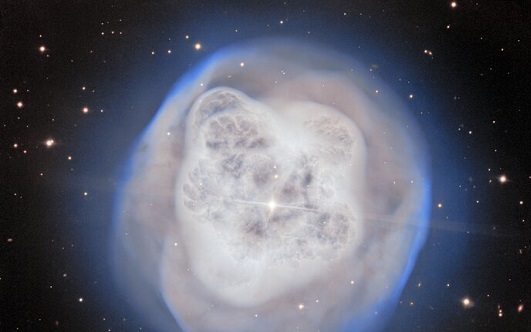
The cosmic splendor of NGC 1514 is revealed in this new image from the Gemini North telescope in Hawai‘i
The 8.1-meter Gemini North telescope, located on the summit of Maunakea in Hawai‘i, has captured NGC 1514, nicknamed the Crystal Ball Nebula, in awe-inspiring detail. This nebula, with its mesmerizing glow of gas, harbors hints of a past stellar death, and its asymmetrical shell is now being shaped by the pair of binary stars that lie at its center.
Tucson, May 22, 2026.- NGC 1514, nicknamed the Crystal Ball Nebula, is showcased in this enchanting image captured by Gemini Multi-Object Spectrograph (GMOS) on the Gemini North telescope, located on Maunakea in Hawai‘i. Gemini North is one half of the International Gemini Observatory, partly funded by the U.S. National Science Foundation (NSF) and operated by NSF NOIRLab.
German–British astronomer William Herschel discovered the Crystal Ball Nebula in 1790. It’s located in the constellation Taurus, near the border of Perseus. While, culturally, crystal balls are known for divining the future, the Crystal Ball Nebula provides us with a snapshot of the final stages of a star’s life from long ago. It sits around 1500 light-years from Earth. This means the light captured in this image left its source around 1500 years ago, traveling across the Universe before finally reaching Gemini North.
The Crystal Ball Nebula is categorized as a planetary nebula, a nomenclature first presented by the nebula’s discoverer, William Herschel. He coined the term in the 1700s after spotting the spherical shape of these objects, which reminded him of planets. In reality, planets and planetary nebulae are unrelated.
Planetary nebulae form when a low- or intermediate-mass star ejects its outer layers near the end of its life, forming a somewhat spherical cloud of gas. They typically have smoother, spherical shapes, making the Crystal Ball Nebula unique for its bumpy shells of gas. As the central star casts away this gas, its inner core is exposed. Radiation from the core energizes the gas, giving it a scorching temperature and chromatic glow. The Crystal Ball Nebula, for example, has an estimated temperature of 15,000 K.
Herschel found this object fascinating, amazed by its faintly illuminated shell. Prior to its discovery, he believed that nebulae were collections of stars that were too far away to individually resolve. The distinct bright point at the heart of the gaseous shell shattered this theory. He wrote in 1791, “Our judgment I may venture to say, will be, that the nebulosity about the star is not of a starry nature.” He believed the illumination of the Crystal Ball Nebula came from a single star, not a far-off grouping.
While it may appear in this image as if there is a single shining light source at the heart of the Crystal Ball Nebula, as Herschel saw, it actually contains two stars. These two stars orbit each other with a period of around nine years — the longest known for any binary pair within a planetary nebula. Scientists believe that one of these stars, which was once several times more massive than our Sun, released its outer layers while in the throes of death. As the progenitor star and its binary companion orbit each other, they mold the expanding shell of gas with their strong, asymmetrical winds, forming the lumpy layers we see today.
More information
This image was produced by NSF NOIRLab’s Communication, Education & Engagement team, as part of the NOIRLab Legacy Imaging Program.
NSF NOIRLab, the U.S. National Science Foundation center for ground-based optical-infrared astronomy, operates the International Gemini Observatory (a facility of NSF, NRC–Canada, ANID–Chile, MCTIC–Brazil, MINCyT–Argentina, and KASI–Republic of Korea), NSF Kitt Peak National Observatory (KPNO), NSF Cerro Tololo Inter-American Observatory (CTIO), the Community Science and Data Center (CSDC), and NSF–DOE Vera C. Rubin Observatory (in cooperation with DOE’s SLAC National Accelerator Laboratory). It is managed by the Association of Universities for Research in Astronomy (AURA) under a cooperative agreement with NSF and is headquartered in Tucson, Arizona.
The scientific community is honored to have the opportunity to conduct astronomical research on I’oligam Du’ag (Kitt Peak) in Arizona, on Maunakea in Hawai‘i, and on Cerro Tololo and Cerro Pachón in Chile. We recognize and acknowledge the very significant cultural role and reverence of I’oligam Du’ag to the Tohono O’odham Nation, and Maunakea to the Kanaka Maoli (Native Hawaiians) community.
Credit:
International Gemini Observatory/NOIRLab/NSF/AURA
Image Processing: J. Miller & M. Rodriguez (International Gemini Observatory/NSF NOIRLab), T.A. Rector (University of Alaska Anchorage/NSF NOIRLab), D. de Martin & M. Zamani (NSF NOIRLab)