








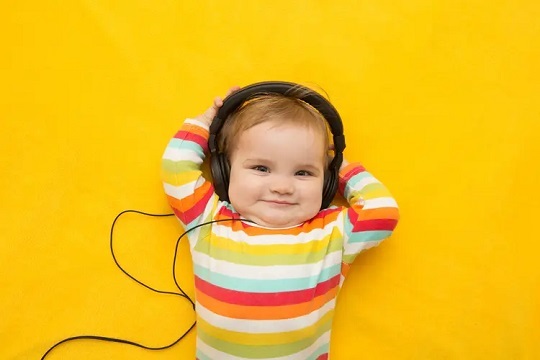
People from all cultures share the ability to recognise music and respond to it with movement. Whilst the processing of music in adults has already been well researched, it has remained unclear until now how and when infants begin to translate heard musical stimuli into spontaneous body movements. An international research team led by Trinh Nguyen and Stefanie Höhl from the University of Vienna and Giacomo Novembre from the Italian Institute of Technology (IIT) has investigated this question in a recent study. They conclude that although the brain processes music from as early as three months of age, complex movement patterns in response to music only develop towards the end of the first year of life. The study is currently published in the journal eLife.
Vienna, July 08, 2026.- When and how do humans actually start dancing to music as part of their development? In a recent project, an international team led by Trinh Nguyen and Stefanie Höhl from the University of Vienna, along with Giacomo Novembre from the IIT in Rome, has investigated how so-called ‘musicality’—in its sensory and motor components—develops during early childhood. Until now, there have been no studies that systematically measure both brain activity and spontaneous body movements in babies whilst listening to music.
Reactions to children’s songs reveal how hearing and motor skills are linked
For the study, the research team played nursery rhymes («La Vaca Lola» and «Hopp Juliska») to 79 infants aged three, six and twelve months. As control conditions, the babies also listened to rhythmically and melodically shuffled versions of the same songs, as well as versions in which the pitch had been deliberately altered.
Whilst listening, brain activity was simultaneously recorded using an electroencephalogram (EEG) and the babies’body movements were analysed via a markerless video-tracking system (DeepLabCut). This enabled the researchers to record and compare the neural responses in the brain as well as the infants’ kinematic movement patterns (e.g. arm rowing, upper body rocking) in synchronisation.
Auditory processing of music begins as early as three months of age
The analysis shows that even three-month-old babies exhibit increased brain activity when listening to structured music compared to random sequences of sounds. «We can therefore see that the auditory processing of music begins very early in development,» says study lead Trinh Nguyen from the University of Vienna.
Structured movements whilst listening to music at the age of one year
The movement data provided a more nuanced picture: a fundamental link between music and movement was measurable across all age groups. However, more complex and structured movement patterns in response to the music only became apparent in twelve-month-old infants. No coordinated synchronisation of movements with the beat of the music could be demonstrated in any of the age groups.
An interesting finding: higher-pitched sounds stimulated the babies’ movements more strongly across all age groups. The study shows how the developing brain gradually learns to translate music into spontaneous movements of increasing complexity.
Even for babies, music is more than just background noise
The results make it clear that, even at a very early age, music is more than just background noise for babies: Even in the first six months of life, the brain processes musical structure, whilst corresponding movement patterns only develop gradually. «For parents, early years professionals and early intervention, this means that singing together, rhythmic rocking and repeated musical routines can be valuable experiences as early as the first year of life – even if babies are not yet visibly moving in time with the beat,» says study lead Stefanie Höhl from the University of Vienna. Music can thus be understood as an early space for interaction in which perception, attention and movement are gradually linked together.
Summary:
Developmental psychologists have investigated the age at which babies or toddlers begin to dance when listening to music. This is a question that has remained unanswered in the research literature to date.
Children’s songs were played to 79 infants aged three, six and twelve months. Brain activity and body movements were measured during the experiment.
Even three-month-old babies showed increased brain activity when listening to music, suggesting that the auditory processing of music begins very early on.
Whilst a fundamental link between listening to music and movement was measurable across all age groups, structured and more complex movements only became apparent in one-year-old toddlers. Higher-pitched sounds stimulated movement in particular.
The conclusion: music is not merely background noise for babies and can be used early on in their development to link perception, attention and movement.
About the University of Vienna:
At the University of Vienna, curiosity has been the core principle of academic life for more than 650 years. For over 650 years the University of Vienna has stood for education, research and innovation. Today, it is ranked among the top 100 and thus the top four per cent of all universities worldwide and is globally connected. With degree programmes covering over 180 disciplines, and more than 10,000 employees we are one of the largest academic institutions in Europe. Here, people from a broad spectrum of disciplines come together to carry out research at the highest level and develop solutions for current and future challenges. Its students and graduates develop reflected and sustainable solutions to complex challenges using innovative spirit and curiosity.
Original publication:
Development of Auditory and Spontaneous Movement Responses to Music over the First Postnatal Year. Trinh Nguyen, Félix Bigand, Susanne Reisner, Atesh Koul, Roberta Bianco, Gabriela Markova, Stefanie Hoehl, Giacomo Novembre. In: eLife
DOI: 10.7554/eLife.107088.3