








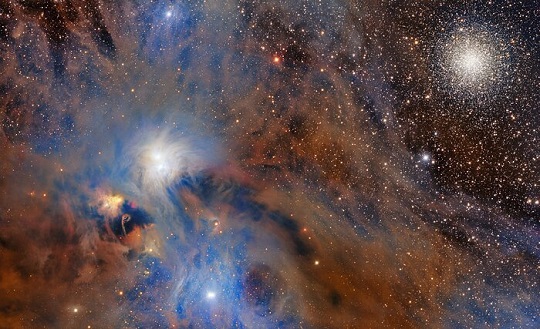
Dark Energy Camera captures stars, nebulae, clusters, and more in a rich, Van Gogh-esque scene
Tucson, July 17, 2026.- The 570-megapixel Department of Energy-fabricated Dark Energy Camera (DECam) captures a vibrant scene, filled with swirls and stars reminiscent of Van Gogh’s The Starry Night. This new cosmic masterpiece features glowing nebula NGC 6729 on the left and globular star cluster NGC 6723 on the right. DECam is mounted on the U.S. National Science Foundation Víctor M. Blanco 4-meter Telescope at Cerro Tololo Inter-American Observatory in Chile, a Program of NSF NOIRLab.
Deep inside the constellation of Corona Australis, Latin for “Southern Crown,” lies a treasure trove of star formation known as the Corona Australis Molecular Cloud. This molecular cloud, which spans the left half of the image, is one of the closest star-forming regions to the Solar System, sitting about 430 light-years from Earth. Together, the field of view is reminiscent of Vincent Van Gogh’s painting The Starry Night, full of bold eddies of celestial color and movement.
This image was captured by the 570-megapixel DOE-fabricated Dark Energy Camera (DECam), mounted on the NSF Víctor M. Blanco 4-meter Telescope at Cerro Tololo Inter-American Observatory (CTIO) in Chile. With a total of 74 detectors and a lens nearly a meter (3.3 feet) across, DECam is capable of taking high-resolution images that capture the details in every cosmic brushstroke.
Embedded in the small glowing orange cloud on the far left is R Coronae Australis, a binary system of two stars that orbit each other every 43–47 years. The primary member is a pre-main-sequence star, meaning it’s accumulated almost all of its mass but hasn’t started fusing hydrogen in its core yet — akin to being in the pre-teen stage of life. In 2019, the companion was discovered to be a red dwarf, the least massive and most common type of all hydrogen-fusing stars. Red dwarfs have relatively cool temperatures and live very long lives compared to hotter and more massive stars like our Sun.
Young stars, like the primary member of R Coronae Australis, are incredibly bright and hot. This star’s light reflects off of the nearby clouds of stellar material, forming illuminated regions known as reflection nebulae. The ultraviolet radiation from the young star is sufficient to ionize the gas surrounding it, creating a glowing region known as an emission nebula. Together, these regions form the dual nebula known as NGC 6729, which shows variations in its brightness and shape due to the orbit of the binary star system within it.
The star-forming regions of this image continue on as the eye travels up and to the right, tracing the clouds of bright blue gas that glow from the newborn stars within. This swirling beige and blue region, punctuated by embedded stars, is composed of the reflection nebulae NGC 6726 and NGC 6727. These nebulae extend to the lower right region, connecting with another reflection nebula known as IC 4812.
Bedazzling the top right portion of this image is the globular star cluster NGC 6723, nicknamed the Chandelier Cluster. NGC 6723 is a gravitationally bound collection of tens of thousands to millions of stars in a spherical shape, with a notably large fraction of younger stars. Even though the glittering cluster appears to neighbor the stellar nursery of the Corona Australis Molecular Cloud, it actually sits far beyond it, at about 29,000 light-years away from Earth.
The Corona Australis Molecular Cloud and the Chandelier Cluster make this region popular among astrophotographers. The constellation Corona Australis in which these objects can be seen, or which they border in the case of the Chandelier Cluster, skirts the southern horizon in summer months for observers at mid-northern latitudes, and is better viewed from farther south. As summer approaches, these objects will be well placed for astrophotographers to capture the scene.