








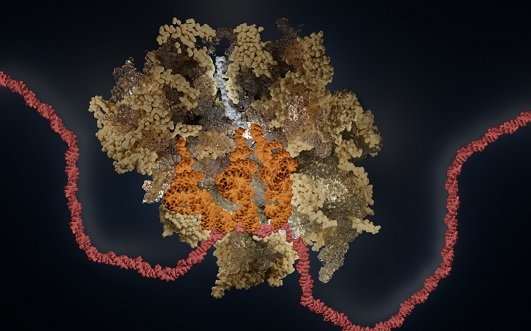
While searching for active compounds that influence fundamental processes in human cells, researchers at the University of Bern discovered a fungal toxin with surprising properties. The toxin shuts down the cell’s “protein factories.” The study provides important insights into one of the most fundamental biological processes – protein production – and could in the long term open up new avenues for developing therapeutic strategies.
Bern, Sept 25, 2026.- Every cell in our body depends on proteins for growth, repair, defense against pathogens, and nearly all other life processes. These proteins are produced by tiny “protein factories”, the so called ribosomes. Disruptions in protein production are linked to diseases such as cancer, developmental disorders, and viral infections. Researchers worldwide are therefore searching for substances that specifically influence protein production, to better understand how ribosomes function and to develop new therapeutic approaches.
A research team at the Department of Chemistry, Biochemistry and Pharmaceutical Sciences (DCBP) at the University of Bern has now developed a new method for specifically identifying substances that influence ribosome function. The study revealed that a specific fungal toxin slows down protein production and puts the cell’s “protein factories” into a sort of dormant state. The study was conducted in collaboration with the Biomolecular Screening Facility at EPFL and the Cryo-EM Knowledge Hub at ETH Zurich, and was recently published in the journal Communications Biology.
28,000 different substances tested using the Bernese method
In order to search specifically for substances that influence protein production, the researchers at the University of Bern did not use traditional tests involving living cells. These are too complex to demonstrate a direct effect. Instead, they developed a test system that mimics human protein production outside living cells. Using this system, they tested 28,000 different substances, measuring how much protein was produced in each case. „By reducing the cells to their essentials, so to speak, we can examine very precisely whether a substance directly influences human protein production“, explains Nino Schwaller, first author of the study and a master’s student at the DCBP. He adds: „Thanks to our new method, we can investigate the effects of environmental toxins and potential active compounds on one of life’s most fundamental biological processes, namely protein production, with much greater precision than before.“
Cereal mycotoxin targets specific targets
Among the many substances tested, the mycotoxin NT‑2, produced by cereal fungi of the genus Fusarium, was particularly striking. These fungi infect wheat, barley, oats and corn, damaging crops and contaminating food and animal feed. The research team has now shown that this NT-2 mycotoxin binds directly to the ribosomes. „We were particularly impressed by how precisely this natural toxin targets the cell’s protein factories“, says Schwaller. Even more surprising was the following observation: „Ribosomes are fundamentally very similar in structure across plants, animals, and fungi, so it would be expected that NT-2 also binds to ribosomes in these organisms and blocks their protein production. Interestingly, the cells of the toxin-producing fungi however appear to be protected themselves from NT-2“, explains Schwaller. The study helps us understand how fungal toxins from contaminated grain can disrupt key processes in human cells.
Ribosomes remain in “sleep mode”
The team made its most surprising discovery when it examined ribosomes from NT‑2‑treated cells more closely. A large proportion of the ribosomes were in a stable but inactive state. “You can imagine the cell’s protein factories being switched into a sleep mode from which they can no longer wake up on their own,” explains Dr. Evangelos Karousis, lead author of the study and research group leader at the DCBP at the University of Bern. “Our observations could explain why certain environmental toxins or medications leave long-term traces in cells,” he adds.
The new study links several research fields: it shows how a toxin from cereal fungi interferes with one of the most fundamental processes in human cells, provides new insights into ribosome function, and at the same time introduces a method for specifically identifying substances that influence protein production. “Many serious diseases are associated with cells producing too many, too few, or the wrong proteins,” says Karousis. “If we better understand how these protein factories can be slowed down or deliberately put into a resting state, this could ultimately help develop new treatments.” The University of Bern is one of the leading centers in the development of innovative methods for analyzing cellular processes. The test platform now presented is a prime example of how researchers in Bern create tools that more closely link basic research with future medical applications. As a next step, the researchers plan to investigate under which conditions “sleeping” ribosomes can be reactivated and how widespread this special resting state is in cells – for example during stress, disease, or exposure to other environmental toxins.
Publication details:
Schwaller N, Andenmatten D, Luginbühl J et al. (2026) A human cell-free translation screen identifies the NT-2 mycotoxin as a ribosomal inhibitor that binds the peptidyl transferase center. Communications Biology. Published on September 23, 2026.
URL: https://www.nature.com/articles/s42003-026-10743-6
DOI: 10.1038/s42003-026-10743-6.
Image©Adrian Bothe