








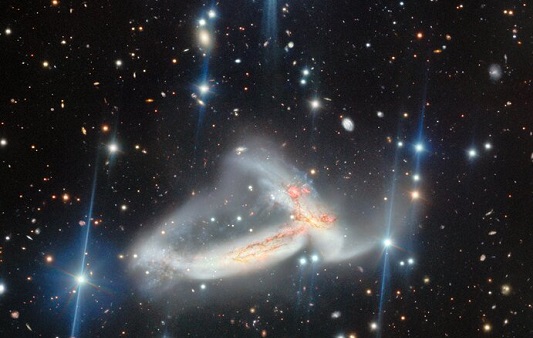
Project Hōkūlani interns researched and named this new Gemini North image featuring the stunning pair of interacting galaxies known as NGC 7253
Tucson, Sept 02, 2026.-Nā ʻUhane Māhoe Huki Pū i ke Ola is the Hawaiian name given to this image of NGC 7253 — a pair of spiral galaxies caught in each other’s gravity. Captured by the Gemini North telescope on Maunakea in Hawai‘i, this image created a spectacular symbolic display for this year’s interns participating in Project Hōkūlani.
Over 200 million light years away, deep within the constellation Ka Lupe o Kawelo (Pegasus), is NGC 7253 — a pair of gravitationally interacting galaxies separated by a distance of about four million light years. This glittering view of their meeting was captured by the Gemini North telescope, one half of the International Gemini Observatory, partly funded by the U.S. National Science Foundation (NSF) and operated by NSF NOIRLab. The new image offers viewers the closest look yet at NGC 7253, and has been named Nā ʻUhane Māhoe Huki Pū i ke Ola, which translates to “The Twin Spirits Pulling Together Creating Life.”
The creation of this image began in October 2025 with three local students from Waiākea High School and the Volcano School of Arts and Sciences participating in the Project Hōkūlani internship. Interns Raiyan Rahman, Rafan Rahman, and Alia Tamanha spent one week at the Gemini North Hilo Base Facility with three goals: learn about observatory operations and how scientific data is collected; deepen their own appreciation for Maunakea; and select an astronomical object for Gemini North to image.
“NGC 7253 is a fascinating object because it’s two galaxies that are merging into one over billions of years. But we mainly picked this object because it was one of the few that actually lay within a Hawaiian constellation, Ka Lupe o Kawelo,” says Raiyan Rahman. “After spending so much time on Maunakea, it was important to us to pick something that was both culturally and astronomically significant.”
In June 2026, three more local students from Keaʻau High School and Kamehameha Schools joined the Project Hōkūlani internship program. Mylin Wilson, Manu Silva-Sampaio, and Samantha Silva-Sampaio shared many of the same goals as their predecessors, and built upon their work by creating a name for the new image of NGC 7253.
The chosen name, Nā ʻUhane Māhoe Huki Pū i ke Ola, is inspired by the dual nature of the interacting galaxies and symbolizes the transformative experience the students had during their summer internship. Each portion of the name corresponds to a different part of the interns’ experience.
Nā ʻUhane Māhoe represents the two similarly sized galaxies and their wispy spiral arms. It also represents the twin nature of the International Gemini Observatory, composed of the Gemini North telescope in Hawai‘i and the Gemini South telescope on Cerro Pachón in Chile.
“ʻUhane (spirit) was an important theme for our group. Our experiences throughout the week — ʻoli (stargazing), visiting the summit, and learning about the awesome scientific discoveries made possible by Maunakea — ignited our own spirits as we prepare for life after high school,” says Samantha Silva-Sampaio.
“ʻUhane in this image reminds us that astronomy is not just science or spirit; it’s both at the same time,” adds Manu Silva-Sampaio.
Huki Pū represents the physical and literal aspect of the galaxies being pulled together, driven by the force of each other’s gravity. It also represents the communities that came together to make Project Hōkūlani a reality.
“Many people from around the world and different areas of expertise came together to make our internship possible, and we learned so much from everyone,” says Wilson. “Our experience, and astronomy itself, is a kākou (collective) type of practice.”
Finally, i ke Ola represents the life that can be created by interacting galaxies. To choose a fitting name for this image, the interns researched interacting galaxies and galaxy mergers. They learned that when spiral galaxies begin to merge, the gas and dust in their spiral arms collide, causing a significant burst in star formation. Extremely hot radiation from the newly born stars ionizes, or energizes, the surrounding gas. When atomic hydrogen is ionized, it forms what are known as H II (pronounced “h-two”) regions, which are visible in this image as concentrations of bright pink light. Manu Silva-Sampaio says, “Stars are sources of life and health for us as human beings, because our Sun is a star, and we cannot live without it.”
Project Hōkūlani operates through a partnership between the International Gemini Observatory and the Project Hōkūlani team at the University of Hawaiʻi at Mānoa. Project Hōkūlani supports middle and high school students in entering postsecondary science, technology, engineering, and math (STEM) fields through strengths- and work-based enrichment programs.
This image was taken as part of the NOIRLab Legacy Imaging Program — a continuation of the program started at the International Gemini Observatory in 2002, called the Gemini Legacy Imaging Program. Its aim is to use observing time on NOIRLab telescopes that is dedicated to acquiring data specifically for color images to share with the public.
Through both of these programs, six local high school students on Hawaiʻi Island get to contribute to the selection, imaging, and naming of a new astronomical image from the Gemini North telescope on Maunakea each year.
More information
NSF NOIRLab, the U.S. National Science Foundation center for ground-based optical-infrared astronomy, operates the International Gemini Observatory (a facility of NSF, NRC–Canada, ANID–Chile, MCTIC–Brazil, MINCyT–Argentina, and KASI–Republic of Korea), NSF Kitt Peak National Observatory (KPNO), NSF Cerro Tololo Inter-American Observatory (CTIO), the Community Science and Data Center (CSDC), and NSF–DOE Vera C. Rubin Observatory (in cooperation with DOE’s SLAC National Accelerator Laboratory). It is managed by the Association of Universities for Research in Astronomy (AURA) under a cooperative agreement with NSF and is headquartered in Tucson, Arizona.
The scientific community is honored to have the opportunity to conduct astronomical research on I’oligam Du’ag (Kitt Peak) in Arizona, on Maunakea in Hawai‘i, and on Cerro Tololo and Cerro Pachón in Chile. We recognize and acknowledge the very significant cultural role and reverence of I’oligam Du’ag to the Tohono O’odham Nation, and Maunakea to the Kanaka Maoli (Native Hawaiians) community.