








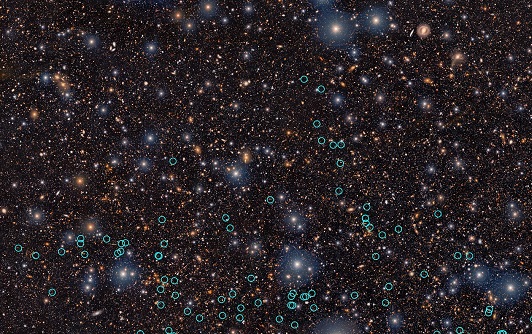
The candidate orbits our Sun beyond Pluto, and may be among the largest and brightest objects discovered in this region of the Solar System.
Tucson, Oct 27, 2026.- In the outer reaches of our Solar System, beyond the orbit of Pluto, NSF–DOE Vera C. Rubin Observatory has spotted 2026 ED138 — a large, bright trans-Neptunian object that scientists have identified as a dwarf planet candidate. The observations were announced today by the International Astronomical Union Minor Planet Center (MPC). If confirmed, ED138 would be among the largest dwarf planets ever discovered in this region of the Solar System.
With observations taken during the run up to the Legacy Survey of Space and Time (LSST), NSF–DOE Vera C. Rubin Observatory has discovered a new dwarf planet candidate in our Solar System. The candidate, which has been given the provisional designation 2026 ED138 (ED138), was found by Rubin Operations team member and in-Kind contributor Matthew Holman (Center for Astrophysics | Harvard & Smithsonian [CfA]). He contributes to improving Rubin’s algorithms that search for distant moving objects in our Solar System. The candidate’s distance from the Sun places it beyond the orbit of dwarf planet Pluto. Initial analysis indicates that it may be among the largest and brightest bodies scientists have discovered in this region of the Solar System.
Rubin Observatory is jointly funded by the U.S. National Science Foundation and the U.S. Department of Energy’s Office of Science.
“Rubin Observatory’s super power is the ability to clearly capture movement and change among a vast number of objects and phenomena that humans have never seen before,” says Edward Ajhar, NSF Program Director for Rubin Observatory. “That power greatly extends our ability to reveal and understand new things about our Solar System, the Milky Way, and billions of other galaxies across the Universe.”
“Rubin Observatory’s unique strengths make it an incredible tool for investigating a wide range of astrophysical phenomena, from dark energy to the discovery of this dwarf planet candidate,” says Kathy Turner, DOE’s Program Manager for Rubin Observatory.
Today, MPC announced the discovery in a Minor Planet Electronic Circular. Mario Jurić, faculty at the University of Washington and Rubin Solar System Lead Scientist, and Holman presented the results at a press conference at the 58th Annual Division for Planetary Sciences (DPS) meeting in Spokane, Washington.
On the evening of 13 October, Holman was running data collected by Rubin earlier in 2026 through a search code he developed with CfA colleague Kevin Napier. The code is built to look at billions of detections of moving objects, compare them, and find the detections that correspond to the same object. Using this method, Holman uncovered ED138, and he immediately noticed that its brightness and distance indicated that it is unusually large.
“My first reaction was one of excited disbelief,” says Holman. “Objects like this are very rare, so I immediately started checking whether I or the code had done something wrong.”
To remove any doubt, a detailed search through the data began in the hopes of uncovering more observations of ED138. Jurić searched Rubin’s catalogs and images and found 20 more observations, going back to 4 March 2026. In all, Rubin observed ED138 30 times on 20 nights between 4 March and 11 July. Additional archival images from the DOE-fabricated Dark Energy Camera (DECam), and uncovered by the Asteroid Institute’s ADAM Precovery service, provided data going all the way back to 2016. These data allowed the team to trace more than 10 years of ED138’s orbit. DECam is mounted on the NSF Victor M. Blanco 4-meter Telescope at Cerro Tololo Inter-American Observatory (CTIO), a Program of NSF NOIRLab.
ED138 is currently at a distance of about 46 astronomical units (au), where 1 au is the average distance between the Earth and the Sun. For reference, dwarf planet Pluto has an average distance of 40 au. This classifies ED138 as a trans-Neptunian object (TNO) — objects that orbit the Sun at a distance greater than Neptune’s.