







The ancestor to a ‘cluster-of-clusters’ of galaxies has a mass 5000 times that of the Milky Way and lies in one of the densest regions of the cosmic web ever observed.
Tucson, Sept 08, 2026.- An international team of astronomers has discovered the most distant progenitor to a galaxy supercluster ever. The discovery supports existing theories of how galaxy clusters evolve, and reveals how they are connected to the larger cosmic web. The study relies largely on data from the ODIN survey, conducted with the U.S. Department of Energy-fabricated Dark Energy Camera on the U.S. National Science Foundation Víctor M. Blanco 4-meter Telescope in Chile.
Galaxy clusters are the most massive gravitationally bound structures in the Universe. These colossal groupings of hundreds to thousands of galaxies span millions of light-years. They are held together by large concentrations of dark matter, which serves as the building block for the larger structure of the Universe.
Clusters that scientists observe relatively near to us in space and time are mature structures that evolved from what are known as ‘protoclusters.’ These protoclusters are enormous, loosely bound collections of galaxies that are in the process of merging together but have yet to settle into a stable cluster. By studying very distant protoclusters that formed when the Universe was relatively young, scientists can understand how modern galaxy clusters grew and evolved over time.
With this goal, an international team of scientists led by Vandana Ramakrishnan, a graduate student at Purdue University at the time of the study, looked billions of years back in time to search for these ancient galaxy cluster progenitors. The team presents their findings in a paper appearing in The Astrophysical Journal. “With this project, we’re hoping to understand the growth of massive structures in the Universe and how they influence the evolution of galaxies within them,” says Ramakrishnan. “We also hope to get a better sense of how these protoclusters are connected to the larger cosmic web.”
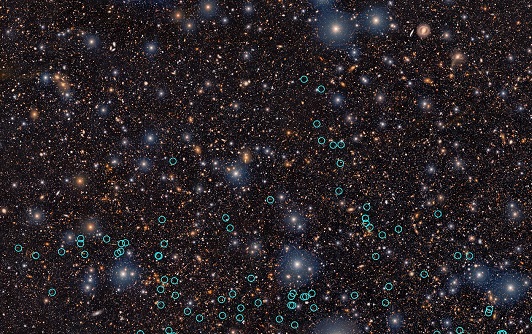
Their study utilized data from the One-hundred-deg2 DECam Imaging in Narrowbands (ODIN) survey. This survey is conducted with the DOE-fabricated Dark Energy Camera (DECam), mounted on the NSF Víctor M. Blanco 4-meter Telescope at Cerro Tololo Inter-American Observatory (CTIO) in Chile, a program of NSF NOIRLab. With its large field of view and 570-megapixel resolution, DECam spent more than 100 nights over the last three years capturing deep images of a huge area of the Southern Hemisphere sky.
In total, the team identified 150 distant protoclusters that formed when the Universe was about 1–3 billion years old. They narrowed their focus to two clusters that showed a striking overdensity of galaxies, dubbed COSMOS-z3.1-A and COSMOS-z3.1-C [1]. The ODIN survey provided the 2D coordinates of these structures’ locations in the sky. However, to get a true sense of their galaxy distribution and how they fit into the large-scale cosmic web, a 3D perspective is necessary.
To map these structures in 3D, Ramakrishnan was joined by two other graduate students, Byeongha Moon (KASI) and Nicole Firestone (Rutgers), to lead follow-up observations using a suite of instruments called spectrographs. Rather than taking a 2D image of the sky, spectrographs use properties of light to measure the distance to an object, allowing scientists to determine its position in 3D.
The majority of spectra used in this study were acquired with the Dark Energy Spectroscopic Instrument (DESI) — a powerful multi-object spectrograph that can measure the distance to 5000 different galaxies simultaneously. The instrument was constructed with support from the DOE Office of Science and international partners and is operated with funding from DOE. The DESI project is managed by the DOE’s Lawrence Berkeley National Laboratory (Berkeley Lab). The instrument is mounted on the NSF Nicholas U. Mayall 4-meter Telescope at Kitt Peak National Observatory (KPNO) in Arizona, a Program of NSF NOIRLab.
The team acquired additional spectra using the Gemini Multi-Object Spectrograph (GMOS) on the Gemini South telescope in Chile, one half of the International Gemini Observatory, funded in part by the NSF and operated by NSF NOIRLab, as well as the DEep Imaging Multi-Object Spectrograph (DEIMOS) on the Keck II telescope located on Maunakea in Hawai‘i.
This study is one of the first to produce such detailed 3D maps of multiple distant protoclusters. The maps allowed the team to predict what kind of clusters COSMOS-z3.1-A and COSMOS-z3.1-C will evolve into. They found that both will evolve to be more massive than the largest known galaxy cluster in our local Universe, the Coma Cluster.
Moreover, they determined that COSMOS-z3.1-A is something even rarer than a protocluster, which is already quite rare. It is a proto-supercluster, or the ancestor of a ‘cluster of clusters’ of galaxies. Having been observed when the Universe was only 2.1 billion years old, this is the earliest, most distant proto-supercluster ever found [2], and it boasts an impressive mass 5000 times that of the Milky Way Galaxy. “COSMOS-z3.1-A represents the most extreme, most overdense regions of the Universe,” says Ramakrishnan. “We think there should be fewer than one such object for every 10,000 galaxy clusters!”
From their detailed 3D maps, the team concludes that these ancient protoclusters are very clumpy and irregular, and that they lie at the intersections of multiple cosmic web filaments. This is the first time scientists have directly observed such features in the distant Universe, and the observations agree with scientists’ expectations of how matter is distributed throughout the cosmos.
Current models suggest that structure formation proceeds in a ‘bottom-up’ manner, with smaller structures forming first and merging together to give rise to larger ones. It is likely that the clumpy substructure seen in the 3D maps is evidence of this bottom-up growth. The clumps will collapse together as the protoclusters evolve, giving rise to clusters similar to what we see in the local Universe, which are much rounder in shape.
With its wide area and depth, ODIN is well-positioned to uncover more of these massive cosmic structures in the distant Universe. “The 3D reconstruction methodology presented in this work will be a vital component of these efforts, enabling us to clearly distinguish the cores and outskirts of the protoclusters, as well as cosmic filaments feeding into them,” says Ramakrishnan.
The team looks forward to more discoveries in the next decade as NSF–DOE Vera C. Rubin Observatory conducts its groundbreaking Legacy Survey of Space and Time (LSST). By imaging the entire Southern Hemisphere sky every few nights, Rubin will create a rich dataset that will complement ODIN’s deep imaging of the overlapping region of sky. Together, the data will create a deep view of the nearby and distant Universe, allowing scientists to study galaxy cluster evolution across cosmic time.