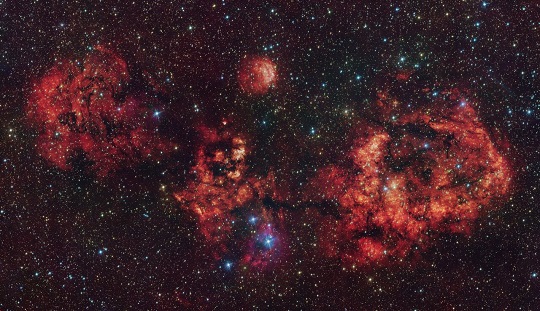








A spooky bat has been spotted flying over the European Southern Observatory’s (ESO’s) Paranal site in Chile, right in time for Halloween. Thanks to its wide field of view, the VLT Survey Telescope (VST) was able to capture this large cloud of cosmic gas and dust, whose mesmerising appearance resemblesContinuar Leyendo

On October 31, the Faculty of Medicine of the University of Bern will hold the event entitled ‘Shaping the Healthcare of Tomorrow’. Experts from clinical practice, research, administration, and patient organizations will jointly discuss how digitalization, AI, and data science will shape tomorrow’s medicine. At the same time, the newContinuar Leyendo

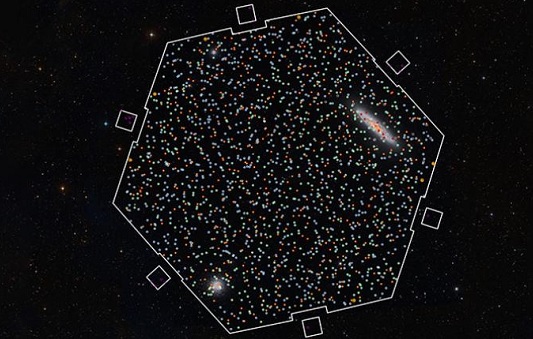
A powerful new telescope has captured its first glimpse of the cosmos, and could transform our understanding of how stars, galaxies and black holes evolve. Cambridge, Oct 24, 2025.- The 4MOST (4-metre Multi-Object Spectroscopic Telescope), mounted on the European Southern Observatory’s VISTA telescope in Chile, achieved its ‘first light’ onContinuar Leyendo

Researchers uncover «diary entries» in fossil fish ear stones using electron microscopy Fossilized fish ear stones – known as otoliths – can reveal far more than previously thought. In a recent study, a team of palaeontologists from the University of Vienna demonstrated that a refined electron microscopy technique can makeContinuar Leyendo

New York, October 15, 2025.- Ant societies are built on scent. Pheromones guide the insects to food, warn them of predators, and regulate the rhythms of their colonies. This chemical communication system is governed by a simple rule: one receptor, one neuron. Ant genomes contain hundreds of odorant receptor genes,Continuar Leyendo

On Mars, dust devils and winds reach speeds of up to 160 km/h and are therefore faster than previously assumed: This shows a study by an international research team led by the University of Bern. The researchers analyzed images taken by the Bernese Mars camera CaSSIS and the stereo cameraContinuar Leyendo

The NASA/ESA/CSA James Webb Space Telescope has provided the first direct measurements of the chemical and physical properties of a potential moon-forming disc encircling a large exoplanet. The carbon-rich disc surrounding the world called CT Cha B, which is located 625 light years away from Earth, is a possible constructionContinuar Leyendo