




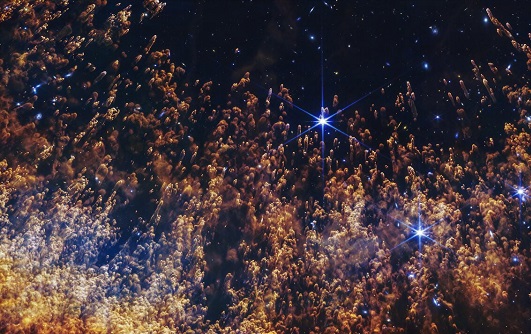
First spotted in the early 1800s, the Helix Nebula has become one of the most iconic planetary nebulas in the sky as it’s recognised for its striking, ring-like shape. One of the closest planetary nebulas to Earth, it has become a favourite among astronomers using ground- and space-based telescopes to study the final moments of a dying star in the greatest detail. The NASA/ESA/CSA James Webb Space Telescope has now leveled those studies up, offering the clearest infrared look at this familiar object.
Washington, Jan 21, 2026.- Webb has zoomed into the Helix Nebula to give an up-close view of the possible eventual fate of our own Sun and planetary system. In Webb’s high-resolution look, the structure of the gas being shed off by a dying star comes into full focus. The image reveals how stars recycle their material back into the cosmos, seeding future generations of stars and planets.
In the image from Webb’s NIRCam (Near-Infrared Camera), pillars that look like comets with extended tails trace the circumference of the inner region of an expanding shell of gas. Here, blistering winds of hot gas from the dying star are crashing into colder shells of dust and gas that were shed earlier in its life, sculpting the nebula’s remarkable structure.
The iconic Helix Nebula has been imaged by many ground- and space-based observatories over the nearly two centuries since it was discovered. Webb’s near-infrared view of the target brings these knots to the forefront compared to the ethereal image from the NASA/ESA Hubble Space Telescope. Additionally, the new near-infrared look shows the stark transition between the hottest gas to the coolest gas as the shell expands out from the central white dwarf.
This blazing white dwarf, the leftover core of the dying star, lies right at the heart of the nebula, out of the frame of the Webb image. Its intense radiation lights up the surrounding gas, creating a rainbow of features: hot ionized gas closest to the white dwarf, cooler molecular hydrogen farther out, and protective pockets where more complex molecules can begin to form within dust clouds. This interaction is vital, as it’s the raw material from which new planets may one day form in other star systems.
In Webb’s image of the Helix Nebula, colour represents this temperature and chemistry. A touch of a blue hue marks the hottest gas in this field, energised by intense ultraviolet light. Farther out, the gas cools into the yellow regions where hydrogen atoms join into molecules. At the outer edges, the reddish tones trace the coolest material, where gas begins to thin and dust can take shape. Together, the colours show the star’s final breath transforming into the raw ingredients for new worlds, adding to the wealth of knowledge gained from Webb about the origin of planets.
The Helix Nebula is located 650 light-years away from Earth in the constellation Aquarius. It remains a favourite among stargazers and professional astronomers alike due to its relative proximity to Earth, and striking appearance.
More information
Webb is the largest, most powerful telescope ever launched into space. Under an international collaboration agreement, ESA provided the telescope’s launch service, using the Ariane 5 launch vehicle. Working with partners, ESA was responsible for the development and qualification of Ariane 5 adaptations for the Webb mission and for the procurement of the launch service by Arianespace. ESA also provided the workhorse spectrograph NIRSpec and 50% of the mid-infrared instrument MIRI, which was designed and built by a consortium of nationally funded European Institutes (The MIRI European Consortium) in partnership with JPL and the University of Arizona.
Webb is an international partnership between NASA, ESA and the Canadian Space Agency (CSA).
Image Credit: NASA, ESA, CSA, STScI, A. Pagan (STScI)