







Findings suggest new drugs under development could potentially protect multiple parts of the brain.
By Leah Eisenstadt
Cambridge, MA, Nov 02, 2026.- In 2025, a team of scientists revealed some unexpected findings about how the inherited DNA repeat associated with Huntington’s disease causes the illness – by slowly expanding throughout a person’s life, then becoming toxic after enlarging to several times its original length. The findings were in a specific brain region, the striatum, but it wasn’t clear if the same process was directly causing the harm in other parts of the brain affected by the disease.
Now, the research team, led by scientists at the Broad Institute, Harvard Medical School, and McLean Hospital, has found that the same mechanism is indeed at play in another brain region damaged in Huntington’s — the neocortex. Appearing online in Cell, the findings suggest that recently initiated efforts to develop medicines targeting this mechanism could protect multiple brain areas.
«These new results suggest that such medicines, if and when they’re successfully developed, might be able to address not just one of the pathologies in the disease, but the two big ones,” said Steve McCarroll, a geneticist, neuroscientist, and co-senior author of the study. McCarroll is an institute member at the Broad, the Dorothy and Milton Flier Professor of Biomedical Science and Genetics at Harvard Medical School, and an investigator of the Howard Hughes Medical Institute.
Repeat discoveries
Scientists have known for decades that people who inherit a version of the Huntingtin (HTT) gene in which a three-letter stretch of DNA («CAG») is repeated 40 or more times are at high risk of developing Huntington’s disease, a fatal neurodegenerative disorder. The 2025 study upended the field. It found that in the striatum, the brain region most damaged in the disease, the inherited HTT mutation becomes toxic only after accumulating 150 or more of the three-letter repeats.
In the new study, the researchers examined the HTT repeats and expression of other genes in more than 125,000 cells from neocortex samples from eleven people who had Huntington’s disease. Just as they saw in striatal cells, cortical cell changes began after a cell’s HTT gene expanded beyond a threshold of about 150 repeats. However, neocortex cells took much longer to reach this threshold — a process that happened so slowly that most of the cells never reached the toxic threshold. This finding could explain differences in disease severity across various parts of the brain.
“It’s satisfying that a single mechanism could be at play in multiple brain areas, explaining pathologies that had once appeared to be so different,” said Seva Kashin, co-first author on the paper and a scientist in the McCarroll lab.
The scientists also revealed that the HTT mutation caused different gene expression changes in cortical cells compared to those in the striatum — another possible explanation for Huntington’s surprisingly variable effects in different parts of the brain.
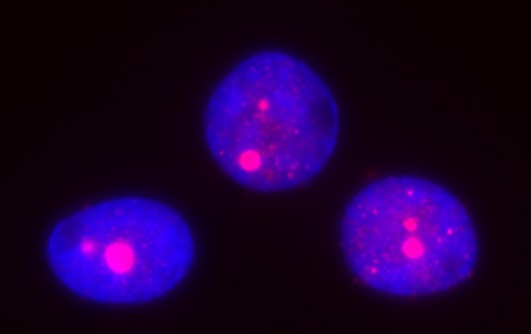
The research team explored another curious, and controversial, observation. A small number of cells in the striatum and cortex of people with Huntington’s disease have accumulations of Huntingtin protein within the nuclei, known as nuclear inclusions. Scientists have long debated whether inclusions were dangerous, irrelevant, or possibly even protective to cells.
This study suggests a new interpretation. Nuclear inclusions occurred in both striatal and cortical cells, but only in cells that had accumulated well over 150 HTT gene repeats and had not yet died — a finding that helps explain why these inclusions are so sparse. The inclusion-carrying human cells also exhibited extremely abnormal gene expression patterns, suggesting that the inclusions are a sign of the cell’s final stage of life.
“Our findings suggest that nuclear inclusions may serve as a red flag that a neuron is undergoing severe molecular dysfunction and may be approaching cell death,” said Won-Seok Lee, a co-first author on the paper and a postdoctoral researcher in the McCarroll lab.
Overall, the results suggest that Huntington’s medicines being developed to slow or stop the repeat expansions could be beneficial not just in the striatum, but also in the neocortex and possibly other regions across the brain to address motor, cognitive, or other symptoms that afflict patients.
“By pointing to a shared disease mechanism across brain regions, our findings suggest these new efforts are on the right track. We hope this evidence adds urgency to developing such treatments,” said co-senior author Sabina Berretta, associate professor of psychiatry at Harvard Medical School and McLean Hospital, a member of the Mass General Brigham healthcare system. She is also the director of the Harvard Brain Tissue Resource Center (HBTRC), an NIH NeuroBioBank center at McLean Hospital.
“Above all, this work is a testament to the extraordinary generosity, commitment, and foresight of brain donors and their families, whose contributions made these discoveries possible and to whom we are deeply grateful.”
Kashin S, Lee WS, et al. Somatic DNA-repeat expansions initiate distinct yet analogous changes in Huntington’s disease cortical and striatal neurons. Cell. October 28, 2026.