








Bern, Sept 22, 2026.- Diamonds are far more than just jewelry: as natural archives, they preserve unique knowledge about the history of our planet. The University of Bern is now receiving one of the world’s largest diamond collections for research and teaching. The collection is being donated to the University of Bern by Dr. Jeffrey W. Harris and his wife Francesca Harris. Among other things, it will contribute to the discovery of new minerals and provide information on the formation of Earth’s interior.
Diamonds are fascinating not only because of their unique brilliance, but also because of the stories they tell from the deep Earth. As diamonds are chemically inert, i.e. extremely resistant and chemically almost unchangeable, they are like time capsules, preserving valuable information about the conditions under which they were formed. The oldest diamonds dated are around 3.5 billion years old, the youngest around 55 million years old – covering a remarkable part of Earth’s 4.6 billion year history. Some diamonds contain tiny high-density fluid, melt or mineral inclusions inside. By examining these inclusions, scientists can gain insights into the evolution of our planet.
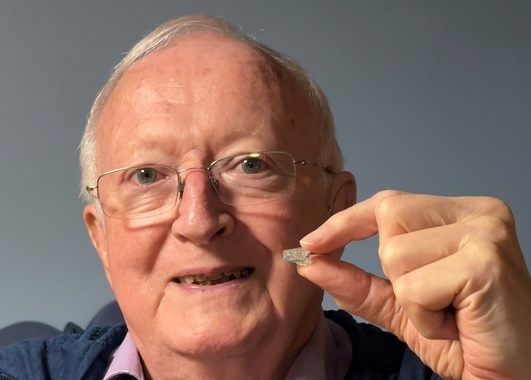
However, the study of such inclusions is only possible if diamond collections are available for research and teaching. One such collection is called «The Harris Diamond Collection». «The Harris Diamond Collection» is now being donated by its current owners Dr. Jeffrey W. Harris, Honorary Research Fellow at the School of Geographical and Earth Sciences at the University of Glasgow, and his wife Francesca Harris, to the University of Bern, which is regarded as a center for diamond research. A key researcher who will use the collection for future research is Suzette Timmerman, Professor for Isotope Geology at the Institute of Geological Sciences at the University of Bern. After more than ten years of collaboration with Dr. Jeffrey W. Harris, he chose Suzette Timmerman as his successor to oversee the collection.
How diamonds show us the history of the Earth
Suzette Timmerman uses the fluids, melts and minerals trapped in diamonds to investigate the chemical evolution of Earth’s mantle, the processes of plate tectonics over time and the formation processes of diamonds. «My research is possible in particular thanks to the unique infrastructure at the University of Bern. The University of Bern is one of the few universities in the world to have its own diamond polishing wheel, diamond-breaking equipment, state-of-the-art mass spectrometry for high precision isotope analyses and other highly specialized equipment and methods for making the chemical composition of materials spatially visible,» says Timmerman.
One of the largest diamond collections for research and teaching worldwide
“The Harris Diamond Collection” is the largest diamond collection for research and teaching in the world. It comprises over 29,000 rough diamonds with an average value of 10 US dollars per diamond. The material value of the collection is therefore limited, but the diamonds are all the more important for research. «This large number of diamonds means that research can be carried out with them for many centuries to come,» says Timmerman.
The rough diamonds come from Africa, South America, North America, Asia and Oceania. The diamonds were donated to Dr. Jeffrey W. Harris by the Diamond Trading Company (DTC) in London for scientific research purposes; each donation is accompanied by its original gift documentation. The collection is stored off-campus.
Discovering new diamond deposits thanks to the collection
In the future, the collection will be used to discover new minerals and to research the movement of fluids in the Earth’s mantle and the so-called deep carbon cycle. «Obtaining diamond samples for research is always a lengthy process that relies heavily on companies donating diamonds for research. ‘The Harris diamond collection’ makes the study of diamond samples much easier,» says Timmerman.
Many samples in the collection come from places that are no longer accessible and have not yet been examined. Timmerman explains: «Studying the diamond collection will therefore help to gain a more comprehensive regional and global overview of the processes of diamond formation and the changes in Earth’s mantle.» A better understanding of the conditions of diamond formation through research will also help to find new diamond deposits. «This is urgently needed as diamonds have many practical applications, for example in medicine or industry, and many diamond mines are nearing the end of their life,” says Timmerman. To a certain extent, the demand for diamonds in the medical sector or for drills in industry, for example, can be met by synthetic diamonds, but currently the market is still largely dominated by natural diamonds.
«The long-term accessibility of the diamonds thanks to the donation of ‘The Harris diamond collection’ also promotes diamond research not only at the University of Bern, but also at other research institutions, museums and gemmological institutes in Switzerland and around the world,» concludes Timmerman.