







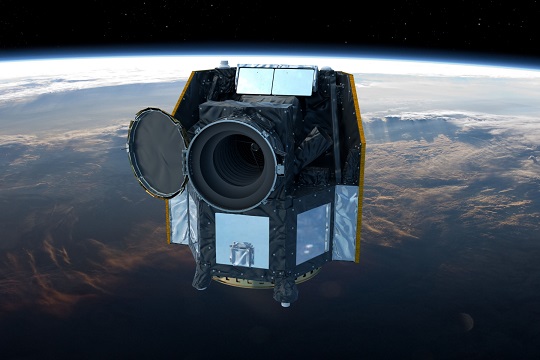
Bern, June 12, 2026.- Following the remarkable scientific achievements of the space telescope CHEOPS, the European Space Agency (ESA) has decided to extend the mission once again. The space telescope, which was built at the University of Bern and whose science operations center is located at the University of Geneva, will now continue to operate until the end of 2029. This decision underscores the outstanding performance and scientific value of CHEOPS in exoplanet research.
CHEOPS is a joint mission of the European Space Agency (ESA) and Switzerland, led by the University of Bern in collaboration with the University of Geneva. Under the leadership of the University of Bern and ESA, a consortium of more than a hundred scientists and engineers from eleven European nations spent five years building the satellite. The CHEOPS science operations center is located at the Department of Astronomy of the University of Geneva. Since its launch from the European Spaceport in French Guiana on December 18, 2019, CHEOPS has revealed the properties of numerous fascinating planets outside our solar system, known as exoplanets. After ESA had already extended the mission by three years in 2023, its Science Programme Committee has now decided on a further extension until the end of 2029.
Dr. Christopher Broeg, principal investigator of the CHEOPS mission and head of the CHEOPS consortium at the Center for Space and Habitability (CSH) at the University of Bern, explains: “The precision of CHEOPS has exceeded all expectations, and the space telescope has become a key component in the arsenal of exoplanet research for astronomers in Europe and worldwide. It bridges the gap between early discovery missions such as Kepler and TESS and next-generation missions such as PLATO, as well as missions designed to characterize exoplanet atmospheres, such as JWST and, in the future, Ariel. The renewed extension of the mission is proof of this and of CHEOPS’ scientific success.” Dr. Andrea Fortier, CHEOPS Mission Manager and from the CSH at the University of Bern as well, adds: “We can now look forward to three and a half more years of exquisite science and fascinating discoveries.”
An unorderly planetary system and a deformed exoplanet
Prof. David Ehrenreich of the Department of Astronomy at the University of Geneva is heading the international team of over a hundred scientists involved in analyzing the mission data. He says: “We are delighted with the scientific insights we have gained thanks to CHEOPS. For example, CHEOPS’s discovery of a new planet orbiting the star LHS 1903 challenges the prevailing theory of how planets are arranged within a system.”
With the help of CHEOPS, the deformation of an exoplanet was detected for the first time. Prof. Monika Lendl from the Department of Astronomy at the University of Geneva and CHEOPS Mission Scientist explains: “Although the planet WASP-103b had already been observed previously using the NASA/ESA Hubble Space Telescope, it was only high-precision measurements taken with CHEOPS that led to an astonishing discovery. Based on small anomalies during the planet’s transit in front of its host star, we were able to determine that it is literally being pulled apart by strong tidal forces. Its shape resembles a rugby ball rather than a sphere.»
Over the next years, CHEOPS is set to build on these successes. “With the mission extension, we can continue long-term observation programs, examine new planetary systems in detail, and target rare phenomena that can only be discovered with a long-term approach,” says Broeg.
Synergies with international space missions
Close coordination with other space missions plays a central role. CHEOPS already works in tandem with telescopes such as the James Webb Space Telescope (JWST): While CHEOPS determines the size, orbit, and sheds light on the structure of exoplanets with its precise brightness measurements, JWST’s spectrographs provide a glimpse into their atmospheres. “Thanks to CHEOPS, we can identify particularly exciting targets for JWSTand select the very best ones – that is how we get the most out of both missions,” explains Ehrenreich.
The mission extension also opens up opportunities for new, innovative observational methods. CHEOPS will continue to fulfil its core tasks while simultaneously serving as a laboratory in space to test new techniques, such as searching for moons around exoplanets or achieving even more precise determination of the exoplanets’ internal structure. “We hope this will give us a much more comprehensive picture of how planetary systems form, evolve, and how diverse they can be,” says Lendl.
Strengthening Switzerland as a hub for research and innovation
Through the efficient use of existing resources and close collaboration between universities, industry partners, and ESA, CHEOPS is sustainably strengthening Switzerland as a hub for research and technology. “High-precision technologies, software developments, and data analysis methods created as part of space missions are incorporated into other projects – from future space telescopes to applications outside the space sector, generating technological innovation while strengthening international scientific and industrial partnerships,” explains Fortier. “The renewed extension of the mission through 2029 underscores Switzerland’s leading role in exoplanet research. CHEOPS thus remains a cornerstone for the transition from exoplanet discovery to their detailed characterization,” Broeg concludes.
Image: © ESA / ATG medialab